"Source Production Control" series (1) First acquaintance with CentOS 8
**Author's note: **Currently in the field of software development at home and abroad, the growing trend of open source teams has reached new heights with Microsoft's acquisition of Github. Many industry giants such as Google, Facebook, IBM, Oracle, Amazon, Tencent, Ali, etc. are also in the open source community It contributes its own wisdom and promotes the open source concept and atmosphere. With the vigorous development of open source, localized software is also gaining momentum. A series of localized software represented by Alibaba Cloud OceanBase, relying on their strong business background and a certain amount of business demand tempering, has become localized software The pioneers in this field have driven more companies in the industry to join this torrent. The prevalence of these two powerful east winds, along with the uncertainty of macroeconomic trade, has ignited the spark of "independent and controllable" core technologies in the national core industries. Open source, localization, independent and controllable, what kind of sparks will emerge from the collision of the three topics? The topic of "source production control" came into being here.
The topic of "Source Production Control" in Huixiang Technology Corner will focus on technologies in the three directions of open source, localization, and independent control. Using operating systems, middleware, databases, and program applications as a rough classification, update the development trends of related technologies, Explore the in-depth use of the core technology, systematically summarize the overall structure of the technology, provide considerable information for learners of related technologies, and also provide personal synchronized learning and summary notes for readers.
The first article of this series, that is, this article, starts with the introduction of the recently updated open source operating system CentOS 8, and gives a brief introduction to CentOS 8. In the future, the open source operating system CentOS 8 will continue to update its basic usage summary and feature usage summary Please stay tuned for a series of articles on other aspects.
What is CentOS##
The following brief introduction is taken from the CentOS Wikipedia entry:
CentOS (Community Enterprise Operating System) is one of the Linux distributions, it comes from Red Hat Enterprise Linux (RHEL) in accordance with the open source regulations Compiled from the released source code. Since it comes from the same source code, some servers that require high stability use CentOS instead of the commercial version of Red Hat Enterprise Linux. The difference between the two is that CentOS does not include closed source software. CentOS's main modification to the upstream code is to remove trademarks that cannot be used freely. In 2014, CentOS announced its cooperation with Red Hat, but CentOS will continue to operate under the new committee and will not be affected by RHEL.
To put it more plainly, CentOS is an open source alternative to the commercial version of RHEL released by Red Hat, and one of the more mainstream open source operating systems used as a Linux server.
CentOS first came into contact with it in 2014, the year that CentOS and Red Hat announced their cooperation. I was also impressed by the CentOS 7 released that year. After its cooperation with Red Hat, it introduced some new features of RHEL 7 such as systemd, which resulted in a large gap between its operations with CentOS 6, and the new system There are few tutorials, and I have been tossing on the system for a long time, and I am deeply impressed.
As of this writing, the latest version of CentOS is CentOS 8-2004, and its basic RHEL version is RHEL 8.2.
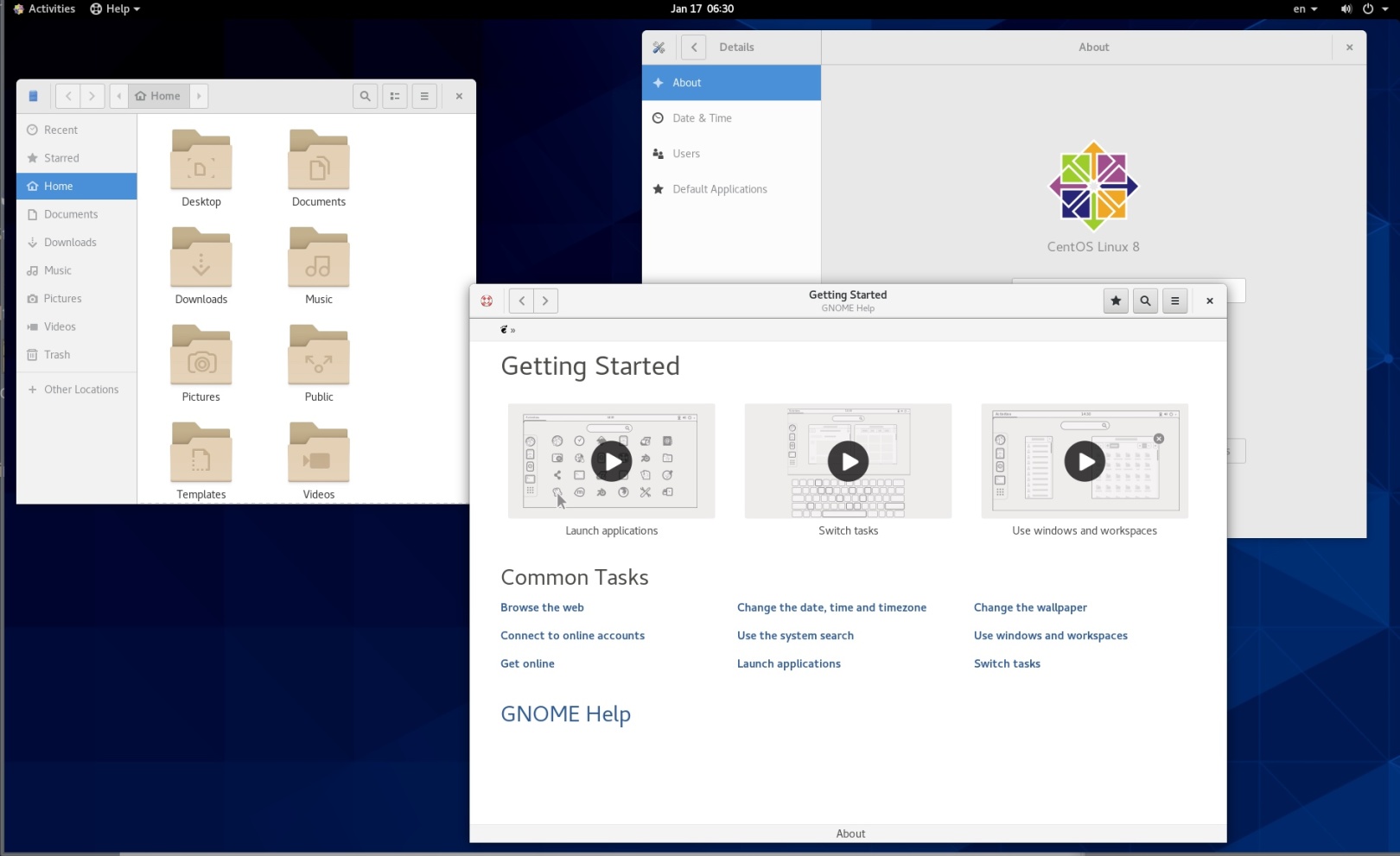 CentOS 8 GNOME desktop interface
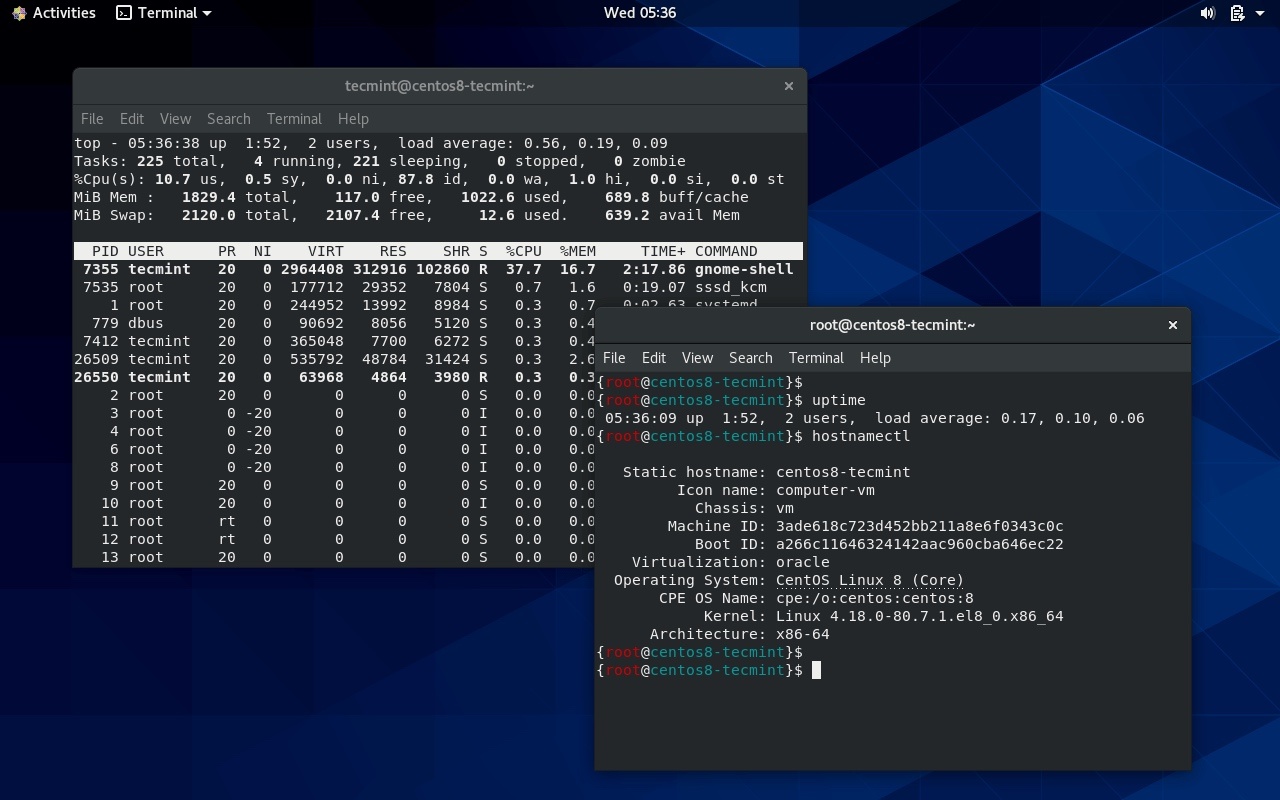 CentOS 8 terminal interface example
New features of CentOS 8##
Regarding CentOS 8, the main features are introduced as follows:
The CentOS project is a 100% compatible reconstruction of Red Hat Enterprise Linux, which fully complies with Red Hat's redistribution requirements, and has released a new version: CentOS 8.0.1905, applicable to all supported architectures.
Following the release of CentOS Linux 7.7, CentOS Linux 8 is now officially released. The new version is based on Red Hat Enterprise Linux 8.0 source, which means that it has all the powerful new features and enhancements of the hybrid cloud era.
CentOS fully complies with Red Hat's redistribution policy and strives to be fully functionally compatible with upstream products. CentOS's modifications to components are mainly to remove Red Hat's trademarks and artwork.
This version also includes the brand new CentOS Streams, CentOS Stream is a rolling Linux distribution, which exists between the upstream development of Fedora Linux and the downstream development of RHEL. You can think of CentOS Streams as a version to experience the latest Red Hat Linux features without having to wait too long.
The main changes of CentOS 8 are consistent with RedHat Enterprise Linux 8. Based on Fedora 28 and kernel version 4.18, it provides users with a stable, secure and consistent foundation, across hybrid cloud deployments, and supports traditional and emerging jobs. Tools required for load. Highlights of this release include:
Release version
Released via BaseOS and application stream (AppStream) repositories.
AppStream is a brand new extension to the traditional rpm format, providing multiple major versions of a component at the same time
Software management
YUM package manager is based on DNF technology, provides modular content support, enhances performance, and provides a well-designed API for integration with other tools
Shell and command line tools
RHEL 8 provides version control tools: Git 2.18, Mercurial 4.8, and Subversion 1.10.
Dynamic programming language, web and database server
Python 3.6 is the default Python environment, with limited support for Python 2.7
Node.js is newly included in RHEL. Other dynamic language updates include: PHP 7.2, Ruby 2.5, Perl 5.26, SWIG 3.0
The database services provided by RHEL 8 include: MariaDB 10.3, MySQL 8.0, PostgreSQL 10, PostgreSQL 9.6, and Redis 5.
RHEL 8 provides Apache HTTP Server 2.4 and Nginx 1.14 which was first introduced.
Squid version is upgraded to 4.4, and Varnish Cache 6.0 is also provided for the first time.
Desktop environment
GNOME Shell is upgraded to 3.28.
GNOME session and display management uses Wayland as the default display server, while RHEL 7's default X.Org server still provides
Setup and image creation
Anaconda installer can use LUKS2 disk encryption and supports NVDIMM devices.
The Image Builder tool can create custom system images in different formats, including various formats that meet the cloud platform
Supports installation from DVD using hardware management console HMC, and also provides Support Element (SE) for IBM Z host
Kernel
Extending the Berkeley Packet Filtering (eBPF) feature allows additional custom programs at various points in the user space, including (sockets, trace points, packet reception), for receiving and processing data. Currently this feature is still in the feature preview stage
BPF Compiler Collection (BCC), which is a tool used to create efficient kernel tracking and manipulation, is currently in the technology preview stage
File system and storage
The LUKS version 2 (LUKS2) format replaces the old LUKS (LUKS1) format. The dm-crypt subsystem and cryptsetup tool now use LUKS2 as the default encrypted volume format
Safety
The default system-level encryption strategy is used to configure the core encryption subsystem, covering TLS, IPsec, SSH, DNSSEC, and Kerberos protocols. Added a new command update-crypto-policies, administrators can easily switch between different modes: default, legacy, future, and fips.
PKCS #11 supporting smart card and hardware security module (HSM)
The internet
nftables framework replaces iptables as the default network packet filtering tool
The firewalld daemon uses nftables as the default backend
Supports IPVLAN virtual network driver for connecting multiple containers
eXpress Data Path (XDP), XDP for Traffic Control (tc), and Address Family eXpress Data Path (AF_XDP), which can be used as part of Berkeley Packet Filtering (eBPF) extended features, are still in the technology preview stage.
Virtualization
The virtual machine created in RHEL8 now supports and automatically configures more modern PCI Express-based computer types (Q35). This provides multiple improvements in the functionality and compatibility of virtual devices.
You can now use the RHEL8 Web console (also known as the "cockpit") to create and manage virtual machines.
The qemu emulator introduces the sandbox function, which provides configurable restrictions on the operations that the system can call qemu to perform, thereby making the virtual machine more secure.
Compiler and development tools
The GCC compiler is updated to version 8.2, supports more C++ standards, better optimization and code enhancement technology, improved warnings and hardware feature support
Different code generation, manipulation and debugging tools can now handle the DWARF5 debugging information format (experience stage)
The core tools that support eBPF debugging include BCC, PCP, and SystemTap.
glibc library upgraded to 2.28 to support Unicode 11, updated Linux system calls, key improvements are mainly in DNS stub resolver, additional security enhancements and performance improvements
RHEL 8 provides OpenJDK 11, OpenJDK 8,<span> </span>IcedTea-Web, and different Java tools such as Ant, Maven, or Scala.
High availability and clustering
Pacemaker cluster resource manager has been updated to the latest version 2.0.0, a series of bugs have been fixed and functions have been improved
The pcs configuration system fully supports Corosync 3, knet, and node name
Related Links
CentOS 8 official release notes:
https://lists.centos.org/pipermail/centos-announce/2019-September/023449.html
Please see the complete RedHat 8 release notes
At present, compared with the modifications of CentOS 6->7, the modification of CentOS 8 requires a lot of changes in the system management level. In addition, the gradual promotion of the cloud management environment also adds the characteristics of the cloud. .
Recommended Posts